

Why Does My Cat Bite Me When I Pet Her? Understanding Feline Behavior, Triggers, and Solutions
If you have ever been happily stroking your cat, enjoying her purring and affectionate nuzzling, only to suddenly feel her teeth sink into your hand, you are far from alone. This is one of the most common questions cat owners ask: why does my cat bite me when I pet her? The behavior can feel confusing, even hurtful, especially when it seems to come out of nowhere. One moment your cat is leaning into your touch, and the next she is nipping, swatting, or biting as though you had done something wrong. The truth is that this behavior is neither random nor a sign that your cat dislikes you. It is a form of communication rooted in feline biology, sensory processing, past experiences, and body language that many owners simply have not learned to read yet.
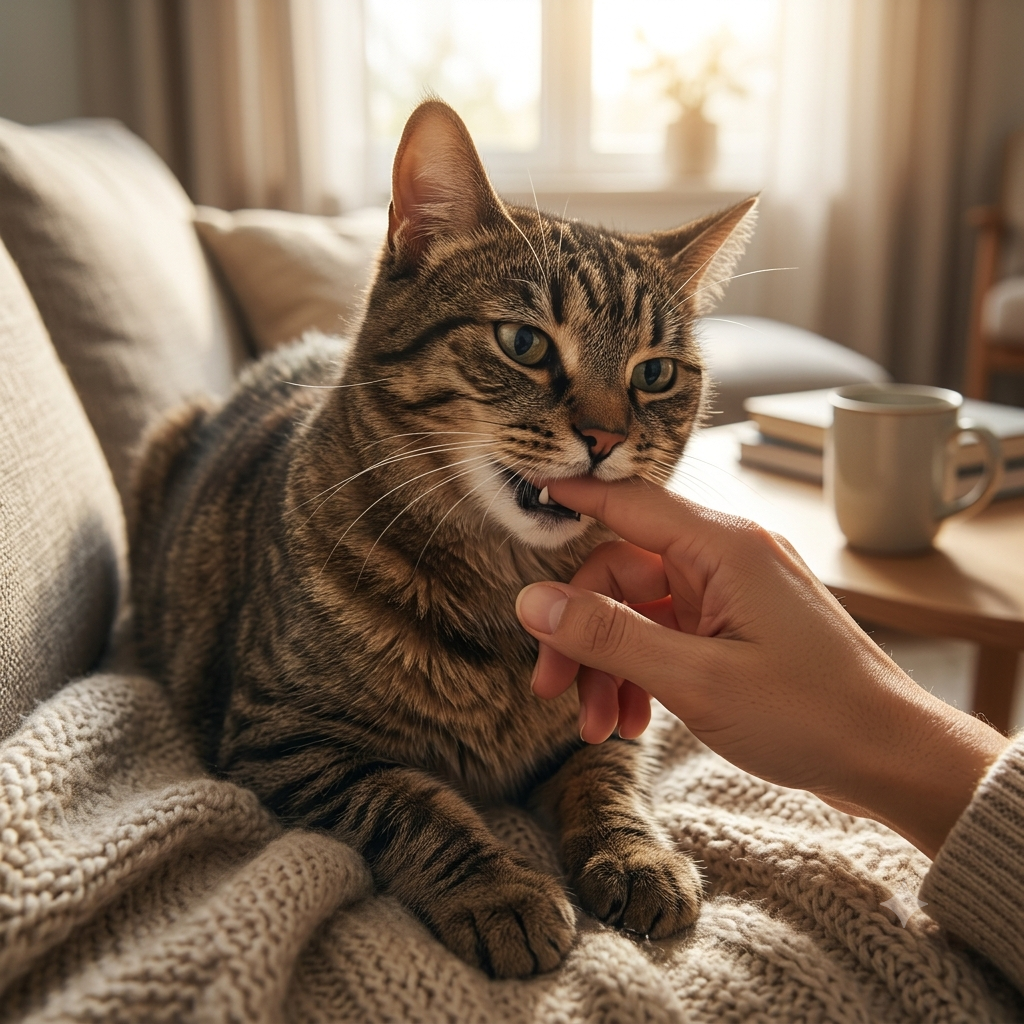
Cats are complex, sensitive animals with communication styles very different from dogs or humans. While dogs tend to be more overtly expressive and tolerant of prolonged physical contact, cats have a much narrower window of comfort when it comes to touch. Understanding why this happens requires looking at feline history, sensory anatomy, emotional triggers, and the subtle cues cats give before they bite. This comprehensive guide explores the phenomenon in depth, covering the origins of petting-induced aggression, how it manifests across different cats and environments, the science behind it, real-life owner experiences, comparisons with other feline behavioral issues, and practical strategies to prevent it. By the end, you will have a thorough, research-backed understanding of why your cat bites you when you pet her and what you can do about it.
The Historical and Evolutionary Roots of Feline Touch Sensitivity
To understand why cats bite during petting, it helps to look at where domestic cats came from. Unlike dogs, which were selectively bred over thousands of years for cooperative behavior and social bonding with humans, cats largely domesticated themselves. Ancient wildcats were solitary hunters who lived independently, defending their territory and relying on sharp instincts to survive. This evolutionary background means that even today’s pampered house cats retain many instincts of their wild ancestors, including heightened sensitivity to touch, a strong startle reflex, and an instinct to protect themselves from anything that feels like a threat, even affectionate touch from their owner.
In the wild, prolonged physical contact was rare outside of grooming between related cats, known as allogrooming, or brief contact during mating and kitten-rearing. Because of this, cats never evolved a biological need for extended petting sessions the way social pack animals did. Domestic cats have adapted remarkably well to living alongside humans, and many genuinely enjoy affection, but their tolerance threshold for physical contact is often much shorter than we expect. This historical context helps explain why a cat might enjoy the first few seconds or minutes of petting but suddenly shift into biting or scratching once her sensory threshold is reached.
What Is “Petting-Induced Aggression” or Overstimulation Biting?
The scientific and behavioral term most commonly used to describe this phenomenon is petting-induced aggression, sometimes called overstimulation biting or petting intolerance. This is not true aggression in the sense of hostility; it is more accurately described as a defensive or overstimulated response. Veterinary behaviorists explain that a cat’s skin and nervous system are extremely sensitive, containing numerous nerve endings that respond quickly to repeated stimulation. What begins as a pleasant sensation can, within a short period, become uncomfortable or even mildly painful, prompting the cat to react defensively.
This reaction typically happens because the same repetitive motion that initially feels soothing eventually triggers a kind of sensory overload. Imagine someone repeatedly touching the same spot on your arm for several minutes. What starts as neutral or pleasant can gradually become irritating. Cats experience this sensation more intensely due to their sensitive skin and heightened nervous system responses, especially in areas like the belly, lower back, and base of the tail.
Common Reasons Your Cat Bites When You Pet Her
There are multiple overlapping reasons a cat may nip or bite during affectionate contact, and identifying the specific cause in your own cat is key to managing the behavior effectively.
Overstimulation and Sensory Overload
This is the most frequent explanation. As mentioned, repetitive stroking, especially in one spot, can overstimulate a cat’s nerve endings. The bite is often a way of saying “that’s enough” after the cat’s tolerance threshold has been reached. You may notice this happens more consistently after a certain number of strokes or a certain duration, which varies from cat to cat.
Touching Sensitive Areas
Certain parts of a cat’s body are far more sensitive than others. The belly, tail base, paws, and lower back are common trigger zones. While some cats enjoy belly rubs, many cats instinctively protect this vulnerable area because, in the wild, exposing the abdomen leaves them defenseless. A hand reaching toward the belly can trigger an instinctive defensive bite even if the cat was previously relaxed.
Redirected Aggression
Sometimes a cat bites during petting not because of the petting itself, but because she is already agitated by something else, such as another animal outside the window, a loud noise, or a stressful event earlier in the day. Since you happen to be nearby and touching her, you become the target of what is known as redirected aggression.
Pain or Underlying Medical Issues
If a cat suddenly starts biting during petting when she never used to, an underlying medical issue could be responsible. Arthritis, dental pain, skin allergies, fleas, or internal discomfort can make normal touch suddenly painful. This is particularly common in senior cats or those with a history of injury. If the behavior appears suddenly and is out of character, a veterinary check-up is strongly recommended before assuming it is purely behavioral.
Fear or Past Trauma
Cats with a history of mistreatment, rough handling, or limited early socialization may associate touch with danger. Rescue cats or those adopted from difficult environments sometimes carry this sensitivity long after they have settled into a loving home. In these cases, biting is a defensive mechanism learned from past negative experiences rather than a reaction to overstimulation alone.
Playful or Communicative Nipping
Not all bites are aggressive. Some cats use gentle mouthing or light nips as a form of communication, similar to how kittens interact with littermates during play. This is especially common in younger cats who have not yet learned that human skin is more sensitive than fur. This type of bite is usually softer, without breaking skin, and often accompanied by relaxed body language.
Reading Your Cat’s Body Language Before the Bite
One of the most valuable skills a cat owner can develop is learning to recognize the warning signs that precede a bite. Cats rarely bite without warning; the signals are simply subtle and easy to miss if you are not paying close attention. Common pre-bite indicators include a twitching or thumping tail, ears rotating sideways or flattening backward, dilated pupils, skin rippling along the back, a sudden stillness or tension in the body, and a low growl or soft hiss. Learning to spot these cues allows you to stop petting before the cat feels the need to escalate to a bite, creating a much more positive interaction for both of you.
The Role of Individual Personality and Breed Tendencies
Just as humans have different comfort levels with physical touch, cats have individual personalities that shape how they respond to petting. Some cats are naturally more tolerant and affectionate, happily accepting long cuddle sessions, while others are more independent and prefer shorter, more controlled interactions. Certain breeds, such as Siamese and Bengal cats, are often described by owners and breeders as having lower tolerance for prolonged handling and a stronger tendency toward overstimulation, while breeds like Ragdolls and Persians are frequently noted for higher physical affection tolerance. However, these are general tendencies rather than strict rules, and individual variation within any breed can be significant. A cat’s early life experiences, socialization with humans during kittenhood, and even her relationship with her specific owner all play a major role in shaping her petting tolerance.
How This Behavior Shows Up Differently Across Home Environments
Interestingly, the intensity and frequency of petting-induced biting can vary significantly depending on the household environment. In multi-pet households, cats may already be operating with heightened stress levels due to territorial dynamics with other animals, making them quicker to react defensively during petting. In quieter, single-cat households, cats often display more relaxed body language and a higher tolerance threshold. Homes with young children sometimes see more frequent biting incidents, not because the cat dislikes the child, but because children may not recognize warning signs and continue petting past the cat’s comfort threshold. Similarly, cats in apartments with less vertical space or hiding spots may experience more baseline stress, which can lower their tolerance for physical contact throughout the day. Recognizing these environmental factors is important because addressing the surrounding stressors can significantly reduce biting incidents, even without changing how you pet the cat directly.
Real-Life Owner Experiences and Success Stories
Many cat owners who have dealt with this issue have found that small, consistent changes lead to major improvements. One common success story involves owners who started tracking how long their cat tolerated petting before showing warning signs, then intentionally stopping a few seconds before that threshold. Over weeks, many owners report that their cats’ tolerance gradually increased as trust built and the interactions remained consistently positive rather than ending in a bite.
Another frequently shared success story involves rescue cats with a history of fear-based biting. Owners who worked patiently, using slow blinking, allowing the cat to initiate contact, and rewarding calm behavior with treats, often saw significant improvement over several months. These stories highlight an important truth: petting-induced biting is rarely permanent or unfixable. With patience, observation, and the right techniques, most cats can be taught to enjoy longer, calmer petting sessions.
Practical Strategies to Reduce or Prevent Biting During Petting
Understanding the causes is only half the equation; applying practical strategies makes the real difference in daily life with your cat.
Start by petting in shorter sessions and paying close attention to your cat’s body language throughout. Rather than continuing until she reacts, aim to stop just before her typical threshold, ending the interaction on a positive note. Focus on areas cats generally prefer, such as the cheeks, chin, and base of the ears, while avoiding sensitive zones like the belly and lower back unless your specific cat has shown clear enjoyment of those areas.
Allow your cat to initiate contact rather than approaching her directly, since cats often feel more secure and in control when they choose the interaction themselves. Watch for early warning signs like tail flicking or ear rotation, and pause immediately when you notice them. Over time, consistently respecting these signals teaches your cat that you listen to her cues, which builds trust and often extends her tolerance for affection.
If your cat is prone to sensory overload, consider incorporating regular play sessions using wand toys or interactive toys to help her release pent-up energy, since a cat with unmet play needs may redirect that energy into biting during petting. Providing environmental enrichment, such as scratching posts, climbing shelves, and hiding spots, can also reduce baseline stress levels that contribute to lower touch tolerance.
Never punish a cat for biting, as this often increases fear and can worsen the behavior over time. Instead, calmly withdraw your hand, avoid eye contact briefly, and give your cat space. Positive reinforcement, such as offering a treat or gentle praise after a calm interaction, tends to be far more effective than any form of punishment.
Comparing Petting-Induced Biting With Other Feline Behavioral Issues
It is useful to distinguish petting-induced biting from other common feline behavioral concerns, since the underlying causes and solutions differ. Play aggression, for instance, typically occurs during active movement, such as when a hand or foot moves quickly near the cat, and is rooted in predatory instinct rather than touch sensitivity. Fear aggression usually arises in response to a perceived threat, such as a stranger, loud noise, or unfamiliar environment, and is accompanied by more dramatic body language like a puffed tail or arched back. Territorial aggression tends to occur around resource guarding, such as food, litter boxes, or preferred resting spots, and is less connected to physical touch itself.
Petting-induced biting is unique in that it often occurs during otherwise calm, affectionate interactions, and the trigger is the physical stimulation itself rather than fear or competition. Recognizing which category your cat’s behavior falls into is essential because the management approach differs significantly. A cat displaying fear aggression needs a very different response than one showing simple overstimulation during petting.
When to Consult a Veterinarian or Feline Behaviorist
While petting-induced biting is usually a normal behavioral response, there are situations where professional input becomes important. If the biting behavior appears suddenly in an older cat or one who previously tolerated petting well, a veterinary examination is strongly advised to rule out pain, arthritis, dental disease, or other medical issues. If biting is severe, draws blood frequently, or is accompanied by other aggressive behaviors such as unprovoked attacks, hissing at rest, or avoidance of the entire household, consulting a certified feline behaviorist can help identify deeper underlying causes and develop a tailored behavior modification plan. Veterinarians can also help rule out neurological conditions in rare cases where biting is accompanied by unusual twitching, disorientation, or skin rippling episodes known as feline hyperesthesia syndrome.
The Broader Impact on the Human-Cat Bond
Understanding why your cat bites you during petting has effects that extend beyond simply avoiding scratches or bites. It fundamentally reshapes the relationship between owner and cat, moving away from a model where the human dictates the terms of affection toward one built on mutual respect and communication. Owners who take the time to learn and respect their cat’s body language often report a deeper, more trusting bond overall, with their cats becoming more affectionate over time rather than less. This shift also tends to reduce stress for both parties. Cats feel safer because their signals are respected, and owners feel more confident and less anxious about unpredictable bites. In multi-person households, when everyone, including children, is educated on reading feline body language, incidents of biting typically decrease significantly, creating a calmer and more harmonious home environment for the entire family, including other pets.
Long-Term Outlook and Future Considerations
For most cats, petting-induced biting is a manageable behavior rather than a permanent personality trait. As kittens mature into adults, many naturally become more tolerant of handling, particularly if they have had consistently positive experiences with touch. Similarly, adult cats can often be gradually desensitized to longer petting sessions through patient, consistent training that respects their limits rather than pushing past them.
Emerging research in feline behavior continues to deepen our understanding of sensory processing in cats, and many veterinary behaviorists now emphasize a more individualized, cat-led approach to affection rather than a one-size-fits-all method. As more owners become educated about feline body language through resources, veterinary guidance, and behaviorist consultations, incidents of petting-induced biting are likely to decrease across the wider cat-owning population, leading to safer and more fulfilling relationships between cats and their human companions.